
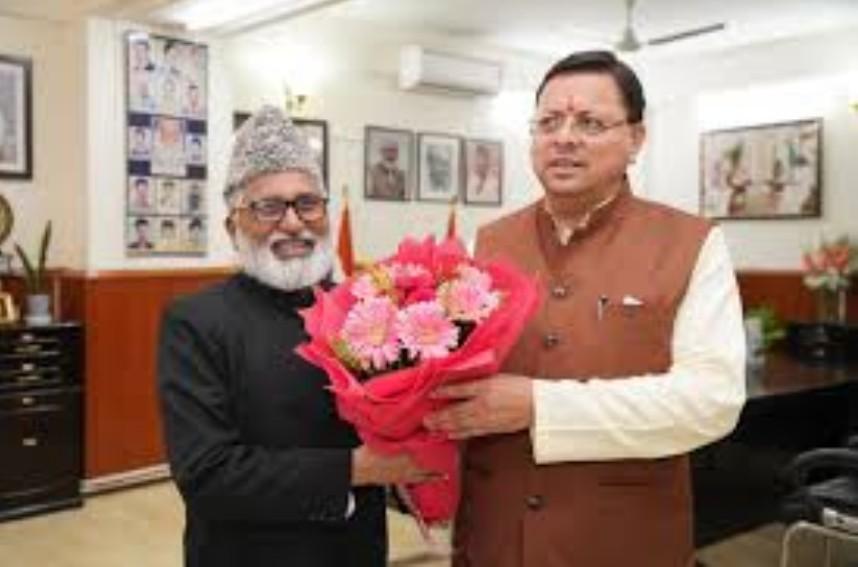
Dehradun: There is a common perception regarding the Dhami government in Uttarakhand that it is working against minorities. Whether it is the implementation of the Uniform Civil Code (UCC), the abolition of the Madrasa Board, or action against madrasas and shrines, many Muslims are unhappy with these decisions. However, Shamoon Qasmi, Chairman of the Uttarakhand Madrasa Education Board, describes these measures as steps taken in the interest of minorities.
Qasmi said that under the leadership of Chief Minister Pushkar Singh Dhami, the Uttarakhand government has taken several major and strict decisions, which it describes as important steps toward protecting cultural identity and ensuring good governance. According to the government, these decisions are not only helping remove illegal encroachments but are also connecting minority youth with modern education and the mainstream.
The state government has decided to abolish the Uttarakhand Madrasa Education Board and form the “Uttarakhand Minority Education Authority.” According to the government, all madrasas and minority educational institutions in the state will now be affiliated with the Uttarakhand School Education Council. Education will be imparted according to the New Education Policy and national curriculum so that students from minority communities can progress in modern education, technical knowledge, and competitive environments.
The government says that earlier, recognition of minority institutions was limited in scope, but now institutions belonging to Muslim, Sikh, Jain, Buddhist, Christian, and Parsi communities have been brought under one authority. This, it claims, will increase transparency and accountability in the education system.
Meanwhile, the Dhami government has also launched a strict campaign against illegal religious encroachments. Action is underway to remove illegal structures built on government and forest land. According to the government, thousands of acres of government land have so far been freed from encroachment, and hundreds of illegal religious structures have been removed. The administration claims that investigations at several places revealed cases where land was occupied in the name of religious sites.
Uttarakhand has become the first state in the country to implement the Uniform Civil Code (UCC). The government says its objective is to provide equal rights to all citizens. Under the law, provisions related to marriage, divorce, property, and women’s rights have been applied uniformly. Registration of live-in relationships has also been made mandatory.
The Dhami government has also implemented a strict anti-cheating law to bring transparency to recruitment examinations. According to the government, this has strengthened young people’s trust in the system and ensured that recruitment exams are conducted fairly.
In addition, schemes such as the Chief Minister Self-Employment Scheme, Mission Apple, and Millet Mission are being run to prevent migration and connect youth with self-employment opportunities. The government says these initiatives are aimed at economically empowering youth, farmers, and women.
The government describes all these measures as important initiatives toward making Uttarakhand a safe, modern, and self-reliant state.