
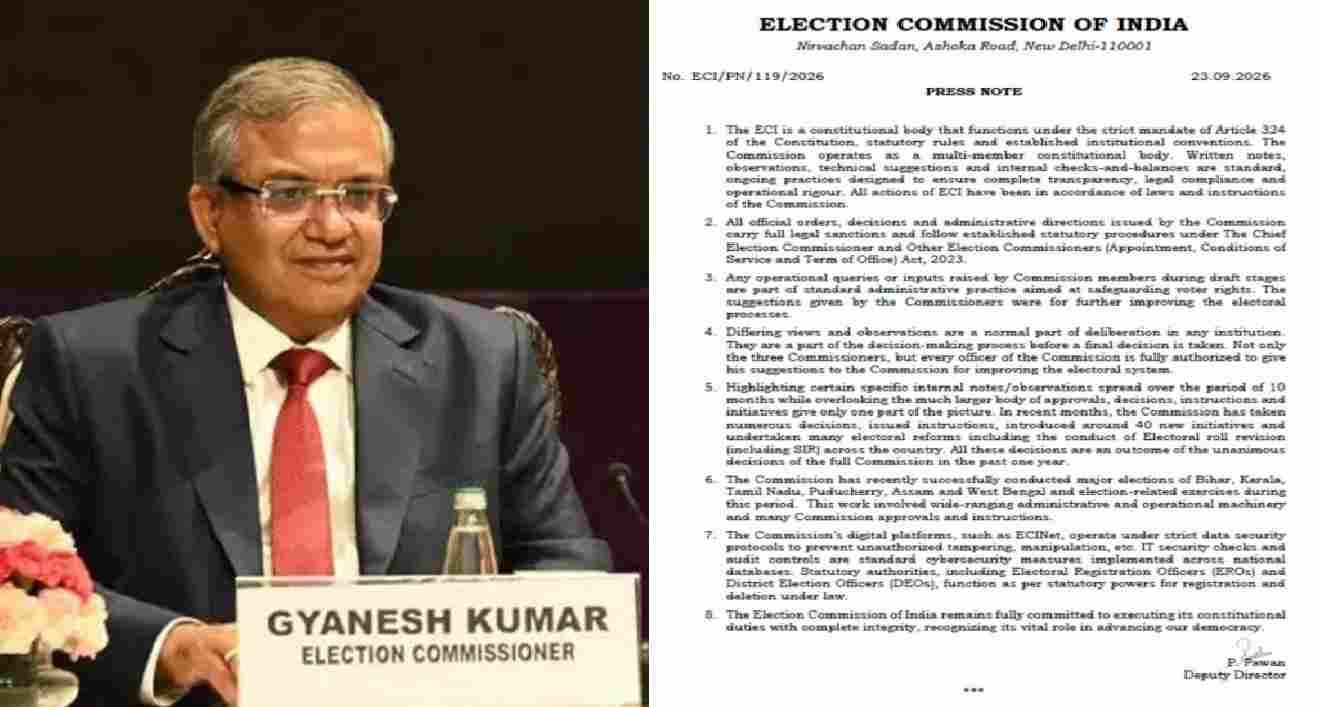
New Delhi. Questions were raised against the Election Commission regarding irregularities in the Special Intensive Revision (SIR). English daily The Indian Express had published a report regarding differences of opinion in the decisions of the Election Commissioners. Issuing a clarification in this matter, the Election Commission has released a press note. The Election Commission has shared all aspects related to the SIR in 8 points, while also explaining the working process of the Commission. The Election Commission clearly stated that all decisions over the past year are the outcome of unanimous consensus across the entire Commission.
Election Commission’s 8-Point Clarification:
- ECI is a Constitutional Body: The Election Commission of India (ECI) functions under Article 324 of the Constitution, legal rules, and established institutional traditions. The Commission operates as a multi-member constitutional body. Written notes, observations, technical suggestions, and internal check-and-balance standards are continuous practices designed to ensure complete transparency, legal compliance, and operational rigor. All actions of the ECI have been carried out in accordance with the Commission’s laws and directives.
- Legal Validity of Orders: All official orders, decisions, and administrative directives of the Commission are fully legally valid and adhere to the statutory procedures laid down under the Chief Election Commissioner and Other Election Commissioners (Appointment, Conditions of Service and Term of Office) Act, 2023.
- Routine Administrative Process: Any operational questions or inputs raised by Commission members during the draft stage are part of standard administrative practice aimed at safeguarding voters’ rights. Suggestions provided by the Commissioners were intended to further refine the electoral process.
- Divergent Views are Normal: Having differing views and deliberations within any institution is a standard part of discussions. They form part of the decision-making process before a final decision is reached. Not just the three Commissioners, but every officer of the Commission is fully authorized to offer suggestions to enhance the election system.
- Unanimous Decisions Over Time: Highlighting a few selective internal notes/observations spread across a 10-month period while ignoring a massive body of approvals, decisions, instructions, and initiatives presents only a partial picture. In recent months, the Commission has taken numerous decisions, issued directives, launched nearly 40 new initiatives, and implemented various electoral reforms, including electoral roll revisions (including SIR) nationwide. All these decisions are the outcome of unanimous approvals by the entire Commission over the past year.
- Successful Execution of Major Elections: The Commission recently successfully conducted major elections and related electoral exercises in Bihar, Kerala, Tamil Nadu, Puducherry, Assam, and West Bengal. This work involved large-scale administrative and operational machinery along with numerous approvals and directives from the Commission.
- Robust Digital Security: The Commission’s digital platforms, such as ECINet, operate under strict data security protocols to prevent unauthorized tampering, manipulation, etc. IT security checks and audit controls are standard cybersecurity measures implemented in the national database. Statutory authorities, including Electoral Registration Officers (EROs) and District Election Officers (DEOs), act in accordance with their legal powers for registration and deletion under the law.
- Commitment to Constitutional Duty: The Election Commission of India remains fully committed to fulfilling its constitutional duties with complete integrity and recognizes its crucial role in advancing our democracy.
What is the Entire Matter?
Following the publication of the report in the newspaper, the Opposition had raised several major questions targeting the Election Commission. Decision-making authority within the Election Commission rests with three officials, including Chief Election Commissioner Gyanesh Kumar and Election Commissioners Sukhbir Singh Sandhu and Vivek Joshi.
The report claimed that decisions were taken on matters without the knowledge of the two Election Commissioners, despite objections raised by both of them.
It was asserted in the report that despite objections from Election Commissioners Sukhbir Singh Sandhu and Vivek Joshi, the Election Commission issued decisions regarding the SIR. It was also stated that objections were recorded at least 14 times over a period of 10 months.
By issuing this press note, the Election Commission has clarified that all decisions of the Election Commission, including those on SIR, were taken unanimously with the approval of both Election Commissioners and the Chief Election Commissioner.