
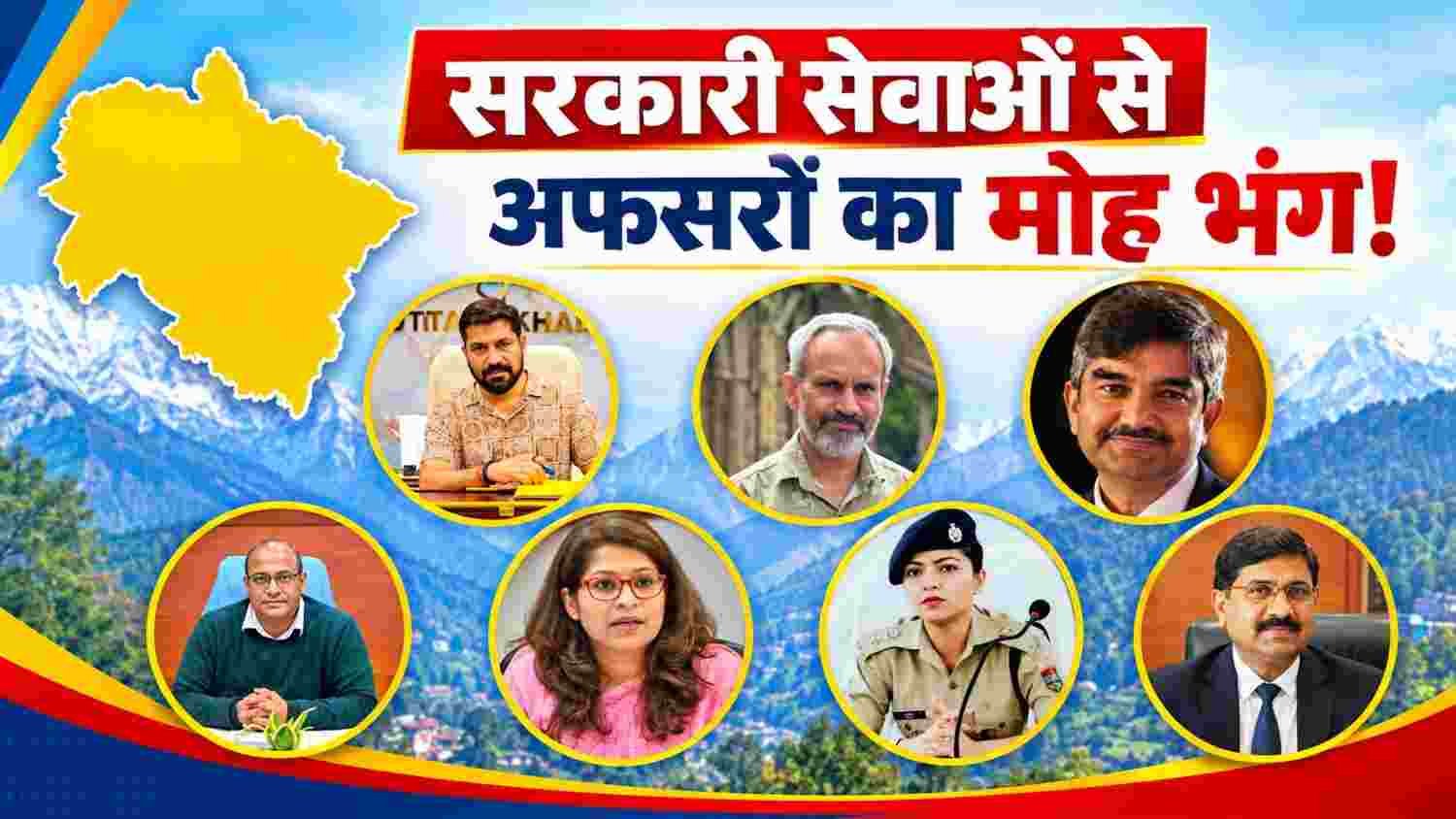
Dehradun: Cases of All India Service officers leaving service ahead of schedule are back in the spotlight in Uttarakhand. Over the past three years, three voluntary retirement cases involving Indian Forest Service (IFS) officers have come to light. The decision of Corbett Tiger Reserve Director Saket Badola to take VRS has brought this topic back into focus. Earlier, Manoj Chandran had applied for VRS in October 2024, while the then Principal Chief Conservator of Forests, Dhananjay Mohan, took voluntary retirement in June 2025.
The Indian Administrative Service (IAS), Indian Police Service (IPS), and Indian Forest Service are counted among the country’s most prestigious services. Selection to these services requires passing rigorous competitive examinations, followed by a long chain of training and administrative responsibilities. Consequently, rising instances of officers leaving service before their prescribed retirement age raise several questions. However, the reasons cited behind the decisions of different officers also vary.
Saket Badola’s Decision Renews Discussion
Corbett Tiger Reserve Director and Indian Forest Service officer Saket Badola made his decision to take voluntary retirement public in October 2026. In his message, he stated that he took this decision for personal reasons after months of deliberations. Describing his service tenure as satisfying, he expressed gratitude for getting the opportunity to work in the field of nature and wildlife conservation.
Saket Badola has served in several important positions within the forest department in Uttarakhand. He has also served as Director of Rajaji Tiger Reserve before taking charge of the Corbett Tiger Reserve. Last year, he was promoted to the post of Chief Conservator of Forests. His decision has drawn attention because his regular retirement is still said to be around 11 years away.
In his public statement, Badola cited personal reasons. He did not attribute departmental pressure or administrative dissatisfaction as the cause for his decision. However, speculations are also rife about him joining a private institution, though no official confirmation has been issued in this regard.
Dhananjay Mohan Left Service Before Retirement
The then Principal Chief Conservator of Forests and Head of Forest Force, Dhananjay Mohan, took voluntary retirement in June 2025. He was a 1988-batch Indian Forest Service officer, and his regular retirement was about two months away. His decision to leave service while holding the topmost position in the state’s forest department became a topic of discussion in administrative circles.
According to information regarding his VRS application, he applied on June 20, 2025, which reportedly received approval the very next day. He had cited personal reasons, though no concrete departmental reason behind his decision was confirmed.
Manoj Chandran’s Case and Administrative Process
In October 2024, Indian Forest Service officer Manoj Chandran applied for voluntary retirement. At that time, he was posted as Chief Conservator of Forests. In his case, the subject of departmental inquiry and chargesheet alongside VRS also remained in discussion.
The then Principal Secretary of Forests, R.K. Sudhanshu, confirmed receiving the application and stated that a chargesheet had been issued against the officer and an inquiry was underway. The dispute revolved around decisions related to promotion and regularization. Manoj Chandran had disagreed with the allegations of rule violations.
Chandran also claimed that after the completion of the mandatory notice period for VRS, his retirement and pension-related procedures did not progress further. Thus, in his case, not only the decision to leave service but also the administrative process associated with it became a subject of discussion.
B.D. Singh Has Also Taken VRS
The list of officers taking voluntary retirement also includes B.D. Singh. He was previously an Indian Forest Service officer and served as the Chief Executive Officer of the Badri-Kedar Temple Committee for a long period before taking VRS.
IAS and IPS Officer Cases Also Came to Light
Cases of leaving service ahead of schedule in Uttarakhand have not been limited to the forest department; names of Indian Administrative Service and Indian Police Service officers have also appeared on this list.
Former IAS officer Umakant Panwar left service several years prior to his regular retirement. His wife and former IAS officer Manisha Panwar also subsequently took voluntary retirement due to health reasons.
Former IAS officer Rakesh Kumar also left service before the stipulated time, later becoming the Chairman of the Uttarakhand Public Service Commission. The names of IAS officer Bhupendra Kaur Aulakh and IPS officer V. Vinay Kumar have also appeared in cases of premature retirement.
IAS officer B.V.R.C. Purushottam applied for VRS citing family reasons, with more than a decade remaining in his service tenure at the time. He had also explored the option of deputation in his home state, but hurdles emerged in the inter-state deputation process.
IPS officers Asim Srivastava and Rachita Juyal have also been among the officers who applied for voluntary retirement. In their cases, the prospect of better opportunities in the private sector was linked to the decision to leave service.
According to retired officer S.S. Pangti, who handled several important responsibilities as an IAS officer in Uttar Pradesh, the circumstances of all officers in these cases were not identical. In some instances, family reasons surfaced, in others, health-related circumstances prevailed, while elsewhere, alternative administrative options were cited.
Balance Between Personal Life and Career Also a Reason
Selection to All India Services has long been associated with a secure career, social prestige, and broad administrative responsibilities. However, cases of premature retirement raise questions about how officers strike a balance between their careers and personal lives.
Opportunities in the private sector, family circumstances, health, the desire to live in one’s home state, and personal priorities can influence such decisions. At the same time, issues related to administrative responsibilities, departmental processes, and the working environment may also be significant in some cases. However, attributing every officer’s decision to a single cause would not be appropriate.
Growing Concern Amid Officer Shortages
Retired Indian Forest Service officer Jayraj states that these cases indicate some officers are choosing to leave prestigious services when offered better financial opportunities. According to him, instances of officers exiting service ahead of schedule need to be understood seriously.
The issue of officer shortages—ranging from the Indian Forest Service to the Indian Administrative Service—has already been raised in Uttarakhand. Under such circumstances, if officers exit before completing their designated service tenure, it can impact the number of available officers.
When applying for VRS, many officers cite personal or family reasons. Consequently, assessing the real reasons behind the decisions is not easy. It is also said that some officers may avoid openly disclosing better options due to apprehensions that their applications might not be accepted.
According to rules, VRS applications are decided under a prescribed procedure. Normally, retirement becomes effective upon the completion of a three-month notice period, provided the government has no solid grounds to withhold it under relevant rules.
The cases of Saket Badola, Manoj Chandran, and Dhananjay Mohan have reignited discussions on premature retirement in Uttarakhand. However, the reasons behind these cases vary, and there is insufficient basis to attribute them all to a single cause. A factual assessment of solid data, circumstances of each case, and administrative procedures is necessary to understand the trend of officers leaving service.