
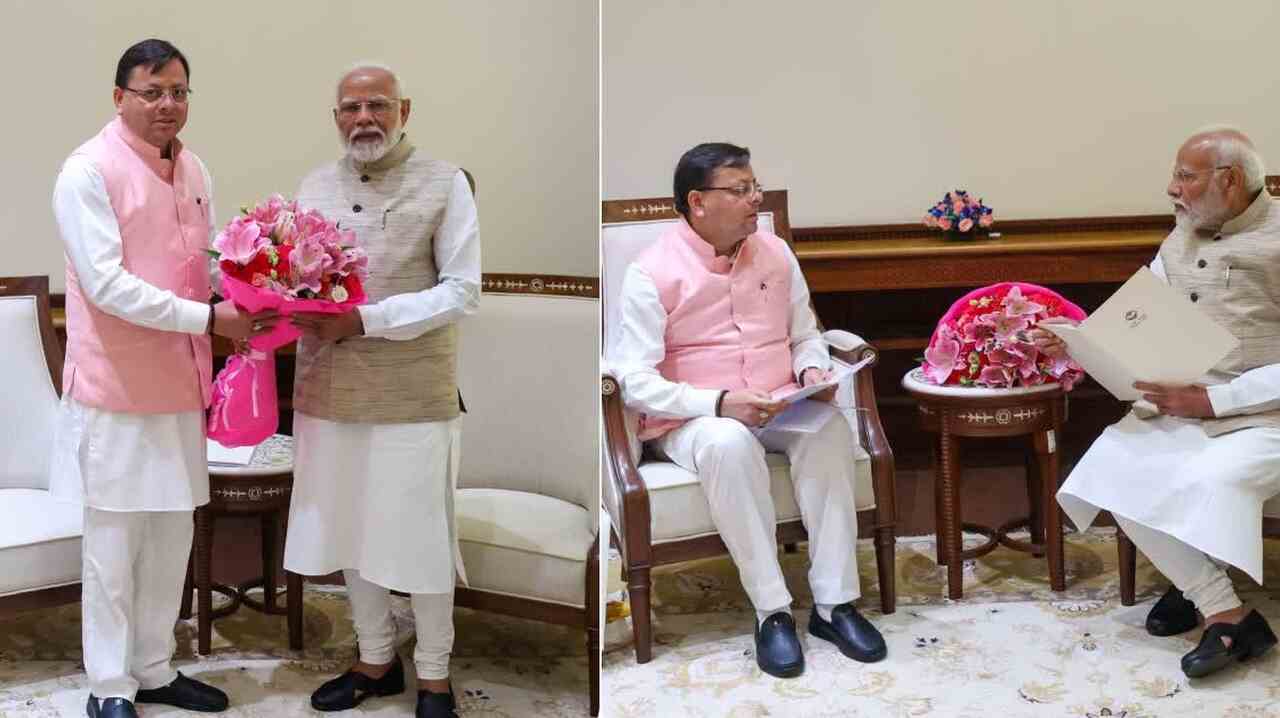
Dehradun: Disaster-affected families in Uttarakhand will now receive higher financial assistance than before. Upon the request of Chief Minister Pushkar Singh Dhami, the Central Government has significantly increased the standards of financial assistance provided under various heads through the State Disaster Relief Fund and the National Disaster Relief Fund. Now, families will get ₹8 lakh instead of ₹4 lakh in the event of a disaster-related death. Similarly, greater financial support will be provided for damages to houses, agricultural land, crops, livestock, and public assets. The revised provisions have become effective for the financial year 2026–27.
Chief Minister Pushkar Singh Dhami and Disaster Management & Rehabilitation Minister Madan Kaushik thanked Prime Minister Narendra Modi and Union Home Minister Amit Shah for this decision. The Chief Minister noted that due to Uttarakhand’s rugged geographical terrain, the state faces natural calamities like floods, landslides, heavy rains, cloudbursts, and snowfall. These disasters cause massive loss of human lives alongside severe damage to agriculture, livestock, housing, and public properties. The hike in relief amounts will offer financial backing to affected families and propel relief and rehabilitation operations.
Under the revised standards, the ex-gratia assistance for death in a disaster has been raised from ₹4 lakh to ₹8 lakh per deceased person, covering personnel involved in rescue and relief missions too. Assistance for 40% to 60% permanent disability goes from ₹74,000 to ₹94,000, and for over 60% disability, from ₹2.5 lakh to ₹3.20 lakh. For severe injuries requiring hospital stay of over a week, individuals will receive ₹20,500, and ₹7,000 if hospitalized for less than a week. Assistance for lost clothing and household items has doubled from ₹2,500 to ₹5,000 per family.
In agriculture and horticulture, rain-fed crop damage compensation is now ₹11,000 per hectare, assured irrigation crops get ₹22,000, and perennial/horticultural crops get ₹30,000 per hectare. Sericulture support has also been increased. Clearing fields covered with more than three inches of silt and sand will now fetch ₹,23,000 per hectare. Landslides and avalanche-damaged agricultural land support is raised from ₹47,000 to ₹60,000 per hectare.
For animal husbandry and fisheries, loss of large cattle (cows, buffaloes, camels, yaks) yields ₹50,000 per animal, while small animals (sheep, goats, pigs) are elevated from ₹4,000 to ₹5,100. Poultry bird loss compensation is set at ₹130 per bird. Fodder in animal camps is allocated at ₹100 daily for large animals and ₹60 for small animals. Fishery support for repairing and purchasing new boats and nets has also been scaled up.
For completely damaged residential houses, assistance in plains rises from ₹1.20 lakh to ₹1.60 lakh, and in hills/remote zones from ₹1.30 lakh to ₹1.70 lakh. Partially damaged concrete houses get ₹8,500 and kutcha houses get ₹5,500. Fully destroyed huts are allotted ₹10,500, and cattle sheds ₹4,000. Handicraft and handloom artisans will receive enhanced aid for lost tools and raw materials.
For public infrastructure repair, state highways and major district roads get ₹1.30 lakh/km in normal regions and ₹1.60 lakh/km in hill tracts. Rural roads receive ₹80,000 in normal and ₹1 lakh per kilometer in hilly tracts. Quick restoration of damaged drinking water schemes and minor irrigation works goes from ₹2 lakh to ₹2.60 lakh.
Power infrastructure restoration covers ₹6,500 per damaged electric pole, ₹70,000 per kilometer for LT line repairs, and ₹1.30 lakh for replacing distribution transformers. School buildings, primary and community health centers damage aid rises from ₹2 lakh to ₹2.60 lakh per unit. Panchayat and community asset losses will receive ₹3.20 lakh.
Disaster Management and Rehabilitation Minister Madan Kaushik stated that the revised benchmarks will empower affected families, farmers, livestock owners, fishers, and artisans with better financial support. Disaster Management Secretary Vinod Kumar Suman confirmed that the enhanced norms apply starting FY 2026-27, and necessary guidelines are being issued to districts for transparent, time-bound distribution.