
Rajasthan: IAS Officers to Serve as ‘Investment Ambassadors’ for Global Summit

In a move set to reshape the role of IAS officers in Rajasthan, Chief Minister Bhajan Lal Sharma has announced a unique initiative aimed at boosting investment in the state. During a press conference held in Mumbai, Mr Sharma revealed that IAS officers will soon be taking on the role of ‘Investment Ambassadors’ as part of the state’s ambitious “Rising Rajasthan” Global Investment Summit 2024.

The Chief Minister detailed the plan, which involves a high-level delegation from the Rajasthan government traveling across India and to over 25 countries globally in a bid to attract significant investment. Over the next two months, the state will launch a comprehensive campaign to engage with potential investors and partners.

As part of this initiative, Sharma disclosed that IAS officers will be assigned specific geographic regions, both domestically and internationally, to foster and maintain continuous communication with entrepreneurs and their governments.

“These officers will act as the state’s representatives in these regions, ensuring sustained engagement with foreign and inter-state companies. Their role will be akin to that of diplomats, but with the added responsibility of coordinating investment efforts from within Rajasthan,” Sharma said.
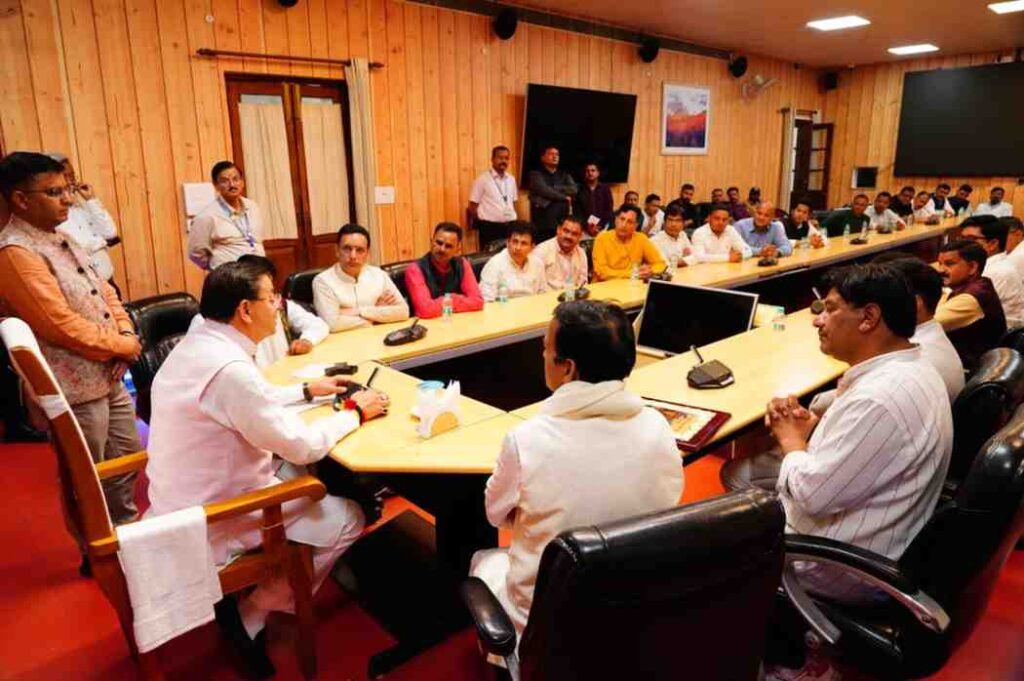
Deliberations on Financial Self-Reliance of Local Bodies, Practical Suggestions from State Finance Commission Dehradun: Chief Secretary Anand Bardhan, along with the Chairman and members of the 6th State Finance Commission N. Ravishankar, held detailed discussions on enhancing the financial self-reliance, administrative capacity, and overall contribution of municipal bodies (Municipal Corporations, Municipal Councils, Nagar Panchayats) and Zilla Panchayats to the state economy. The meeting highlighted that despite multiple opportunities for financial independence, local bodies are not achieving the expected level of self-reliance due to administrative and policy gaps. Constraints include limited local revenue sources, traditional slow work culture, lack of clear bylaws, inadequate land management, and excessive political centralization. The Chief Secretary urged the Finance Commission to provide practical, timely, and implementable suggestions to strengthen the financial capacity of urban and district local bodies. The Commission recommended interventions in land management, revenue-generating bylaws, work culture, adoption of innovations, and effective execution. It also suggested shifting district plan allocations from a distribution-based approach to a need-and-outcome-based model. Commission members P. S. Jangpangi, M. C. Joshi, Secretary Nitesh Jha, Dilip Jawalkar, and Dr. R. Rajesh Kumar, along with relevant officials, attended the meeting.