
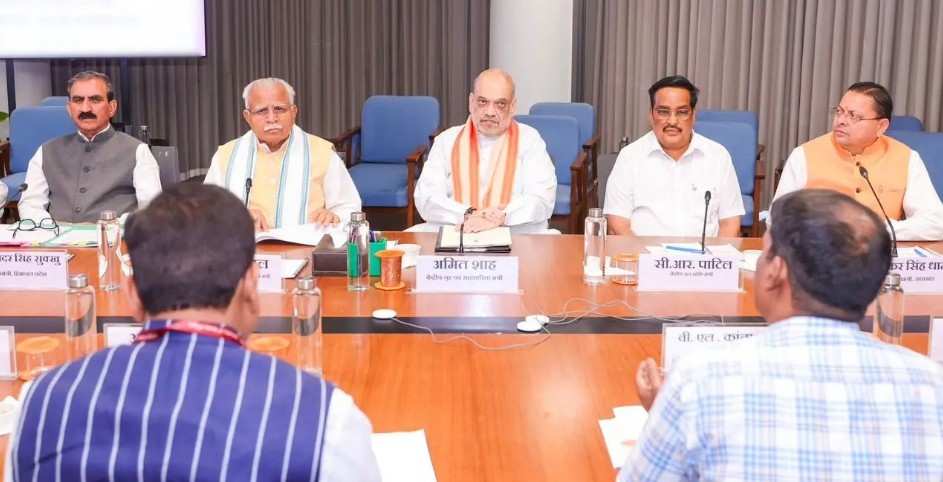
New Delhi: A major breakthrough was achieved on Tuesday regarding the long-pending Kishau Multipurpose Dam Project. At a high-level meeting chaired by Union Home Minister Amit Shah, an agreement was reached among the states of Himachal Pradesh, Uttarakhand, Delhi, Uttar Pradesh, Haryana, and Rajasthan on signing a Memorandum of Understanding (MoU) for the project.
Following the signing of the MoU, the project will be presented before the Union Cabinet for final approval.
The meeting was attended by Union Power Minister Manohar Lal, Union Jal Shakti Minister C. R. Patil, Himachal Pradesh Chief Minister Sukhvinder Singh Sukhu, Uttarakhand Chief Minister Pushkar Singh Dhami, senior officials from the Ministries of Home Affairs, Jal Shakti, and Power, along with the Chief Secretaries of both states.
Delhi and Rajasthan to Bear Himachal Pradesh’s Share of Costs
Under the agreement, 90% of the cost of the water component of the Kishau Project will be borne by the Central Government as central assistance, while the remaining 10% will be shared among the six participating states.
Himachal Pradesh had earlier expressed unwillingness to contribute its share, arguing that the primary beneficiaries of the project would be the downstream states. To resolve the deadlock, it was agreed that Himachal Pradesh’s share of water would be allocated to Delhi and Rajasthan. In return, these two states will bear Himachal Pradesh’s portion of the project cost. Rajasthan had already agreed to provide additional financial support in December 2025.
Asia’s Second-Largest Dam to Be Built on the Tons River
The Kishau Dam is proposed to be constructed on the Tons River, a major tributary of the Yamuna River, between Dehradun district in Uttarakhand and Sirmaur District in Himachal Pradesh.
Key Features of the Project
- Dam Height: 236 meters
- Dam Length: 680 meters
- Power Generation Capacity: 660 MW
- Annual Green Energy Production: 1,379 million units
- Irrigation Potential: 97,076 hectares of agricultural land
Electricity generated by the project will be shared equally between Uttarakhand and Himachal Pradesh, while irrigation and drinking water benefits will be distributed among Uttar Pradesh, Haryana, Delhi, and Rajasthan.
Rajasthan to Receive 10% Additional Water
Upon the completion of major Upper Yamuna Basin projects, including the Renukaji Dam Project, Lakhwar Dam Project, and the Kishau Dam, Rajasthan is expected to receive approximately 10% additional water allocation for the first time. This is expected to significantly strengthen both irrigation and drinking water supplies in the state.
Proposed Yamuna Water Allocation
| State | Water Allocation (Cusecs) |
| Haryana | 6,417 |
| Uttar Pradesh | 4,515 |
| Rajasthan | 1,917 |
| Delhi | 811 |
| Himachal Pradesh | 423 |
According to experts, the implementation of the Kishau Multipurpose Dam Project is expected to provide long-term benefits to several northern Indian states by improving water resource management, irrigation facilities, drinking water supply, and clean energy generation.