
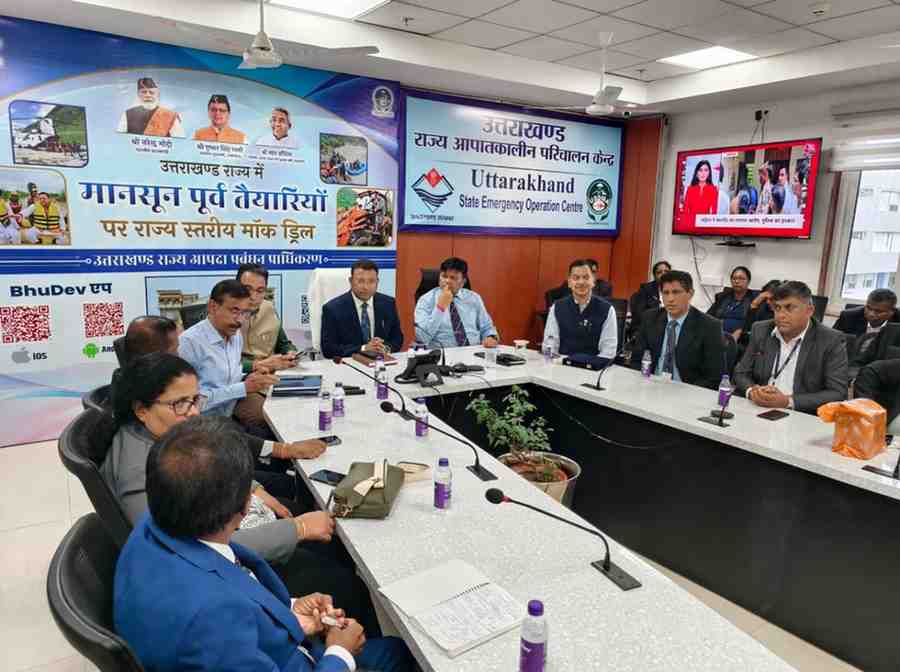
Dehradun: Uttarakhand’s disaster management model is gaining international recognition. On Monday, a 40-member delegation of Sri Lankan civil servants visited the Uttarakhand State Disaster Management Authority (USDMA) as part of a capacity-building programme organized by the National Centre for Good Governance (NCGG) to study the state’s disaster management systems and advanced technologies.
Officials from USDMA briefed the delegation on Uttarakhand’s early warning systems, landslide risk reduction strategies, weather forecasting mechanisms, Emergency Operations Centre, Incident Response System (IRS), and community-based disaster management model. They explained that disaster management in Uttarakhand extends beyond relief and rescue operations, with a strong emphasis on risk reduction, preparedness, and the integrated use of modern technology.
During the visit, meteorological experts demonstrated the functioning of Doppler Weather Radar, Automatic Weather Stations (AWS), Automatic Rain Gauges (ARG), and satellite-based weather monitoring systems.
The Uttarakhand Landslide Mitigation and Management Centre (ULMMC) also showcased the use of advanced technologies such as drone surveys, remote sensing, GIS mapping, and slope stabilization techniques for landslide risk management.
Members of the Sri Lankan delegation expressed particular interest in Uttarakhand’s landslide risk management practices and rainfall-based early warning systems, observing that the state’s experience could be highly relevant for disaster-prone countries such as Sri Lanka.
Vinod Kumar Suman, Secretary, Disaster Management and Rehabilitation, said that such study visits help strengthen international cooperation and capacity building in disaster management. Meanwhile, Dr. A. P. Singh, Associate Professor at the National Centre for Good Governance (NCGG), noted that the institution has so far trained civil servants from 52 countries in the areas of good governance and administrative capacity building.