

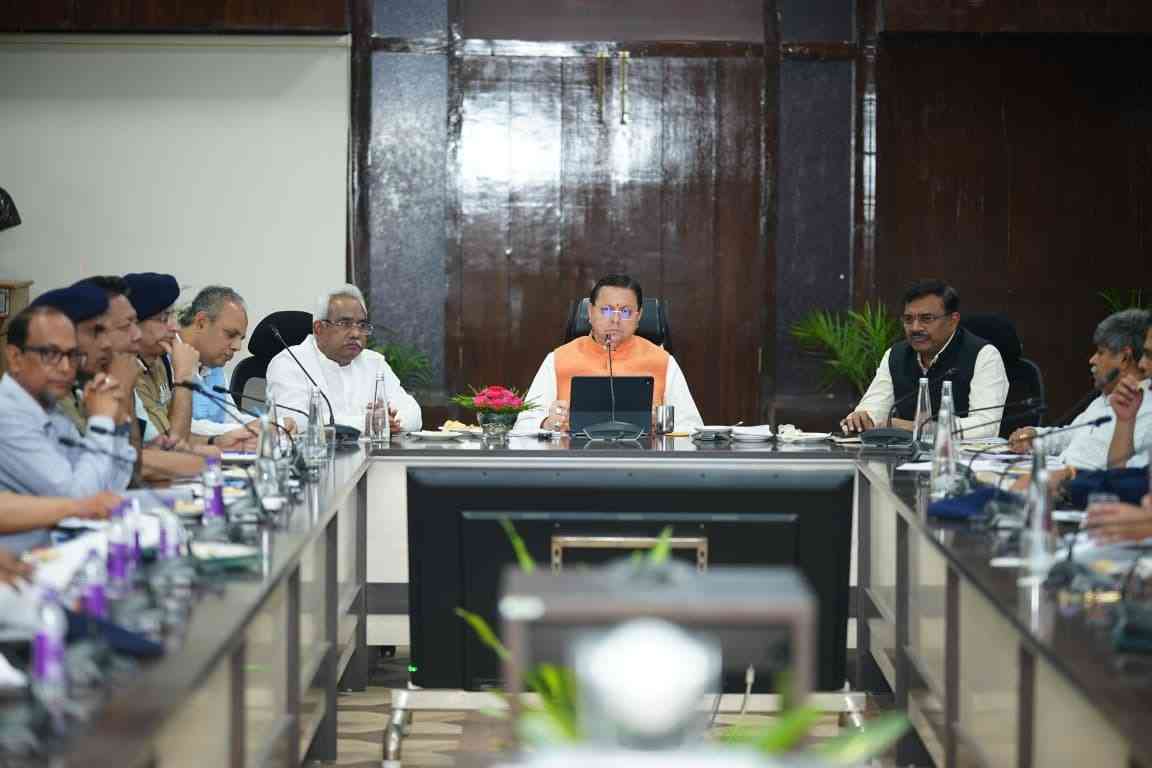
Dehradun: Chief Minister Pushkar Singh Dhami, while interacting with probationers of the Indian Forest Service, said that forest officers are not merely administrative officials but guardians of nature. He said that balancing development with environmental conservation while moving forward is a priority of the Uttarakhand government.
At an event held in Dehradun in the presence of Vice President of India C.P. Radhakrishnan and Uttarakhand Governor Lieutenant General (Retd.) Gurmit Singh, the Chief Minister extended his best wishes to the Indian Forest Service probationers. He said that nearly 70 percent of Uttarakhand’s geographical area is covered by forests. The state’s mountains, rivers, forests and biodiversity are its unique identity. Therefore, forest conservation is not merely an administrative responsibility but a duty linked to securing a safe future for coming generations.
The Chief Minister said that amid the challenge of climate change, the role of forest officers has become even more important. Officers must give priority to the interests of local communities while combining modern technology with administrative efficiency. He said that officers must value responsibilities along with authority, and sensitivity along with knowledge.
13,000 Acres of Forest Land Freed from Encroachment
The Chief Minister said that the state government has taken several steps to strike a balance between environmental conservation and development. Under the anti-encroachment campaign, around 13,000 acres of forest land has been freed from illegal occupation. Uttarakhand is the first state in the country to establish a dedicated Forest Drone Force.
He also mentioned the digital deposit-refund system implemented along the Char Dham pilgrimage routes and said that it would soon be expanded to other parts of the state.
Emphasis on Development Alongside Wildlife Conservation
The Chief Minister said that special care is being taken to ensure that development projects do not come at the cost of the environment. He cited the approximately 12-kilometre-long elevated wildlife corridor on the Delhi–Dehradun Expressway passing through Rajaji Tiger Reserve as an example of balancing modern infrastructure with wildlife conservation.
He said that the National Transit Pass System has been implemented in the state to facilitate the transportation of forest produce. The ex-gratia compensation in cases of human fatalities due to human-wildlife conflict has been increased to ₹10 lakh. Necessary amendments have also been made to the rules to strengthen Van Panchayats.
Focus on Preventing Human-Wildlife Conflict
The Chief Minister said that measures such as bio-fencing, rapid response teams and the 24-hour wildlife helpline 1926 are being strengthened to reduce human-wildlife conflict. Work is also underway to provide life insurance to fire watchers engaged in combating forest fires and to generate employment for rural communities through the collection of pine needles (pirul).
The Chief Minister said that the government’s objective is to establish a balance in which nature and wildlife remain protected while the livelihoods of local communities dependent on forests are also strengthened. He called upon the young Indian Forest Service officers to give the highest priority to national interest, environmental conservation and public welfare.